One of the most common requests I receive from nursing students is for a more detailed study guide. At first glance, it may appear that students simply want to know what will be on the examination. However, after years of teaching prelicensure nursing students, I have come to believe that many are asking for something else entirely. They are looking for direction, reassurance, and help navigating the overwhelming volume of information presented in nursing courses.
Many students enter nursing programs with study habits that emphasize memorization and recall. Success in nursing, however, requires much more than remembering facts. Students must learn to recognize clinically significant cues, prioritize patient needs, apply knowledge to unfamiliar situations, and explain the rationale behind clinical decisions. The development of clinical reasoning and clinical judgment has become an increasingly important focus in nursing education (Gonzalez et al. 2021; Camp-Spivey et al. 2024).
I began to realize that when students asked for increasingly detailed study guides, they were often struggling to identify what was most important and how to organize their learning. Some students were refreshingly honest and simply asked, “Can you just tell us exactly what to study?” Although a few may have been looking for a shortcut, many were really asking for guidance and reassurance. Rather than creating increasingly detailed study guides, I decided to create learning activities that would help students practice the thinking processes required in nursing practice.
The Strategy
To help students move beyond memorization and toward clinical reasoning, I began incorporating recognition-based clinical judgment worksheets into my courses.
These faculty-developed worksheets use brief patient scenarios paired with open-ended questions, prioritization activities, and application-based questions. Rather than asking students to recall isolated facts, the worksheets require them to identify meaningful patient cues, explain their reasoning, prioritize concerns, and justify nursing decisions. Similar educational strategies that emphasize application and active engagement have been associated with the development of clinical judgment in nursing students (Watkins et al. 2025).
The worksheets are not intended to replace reading assignments, lecture content, or traditional study strategies. Instead, they provide students with a structured way to engage with course content while practicing clinical reasoning.
Figure 1 provides an example of a faculty-developed recognition-based clinical judgment worksheet that can be adapted to course content and learning objectives while promoting cue recognition, prioritization, rationale development, and collaborative discussion.
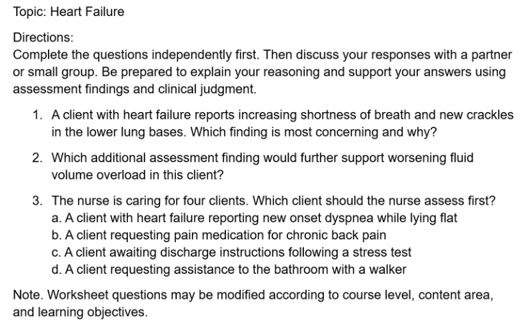
Figure 1. Sample Recognition-Based Clinical Judgment Worksheet
How I Use the Worksheets
Students first complete the worksheet independently. I then use a think-pair-share format that allows them to compare answers, discuss rationales, and consider alternative perspectives before participating in a larger class discussion.
During these conversations, students often discover that classmates approached the same patient scenario differently. These differences create valuable opportunities to discuss clinical judgment, challenge assumptions, and explore multiple reasonable approaches to patient care.
Faculty-guided discussion becomes an important component of the activity. Rather than focusing exclusively on whether an answer is correct or incorrect, discussions focus on the reasoning process used to arrive at a decision. This approach helps students develop the habit of explaining their thinking rather than simply identifying answers. Wankier and Beynon (2025) note that opportunities for students to apply knowledge and engage in clinical reasoning are essential components of clinical judgment development.
One unexpected benefit of this approach has been the quality of classroom discussion it generates. Students frequently arrive at different conclusions based on the same scenario, creating opportunities to explore rationale, examine alternative approaches, and deepen understanding. In many cases, the discussion becomes more valuable than the worksheet itself because students learn not only from faculty feedback, but also from hearing how their peers reason through clinical situations.
Why This Strategy Works
The strategy helps students shift their focus from memorizing content to applying knowledge. Instead of asking, “What is going to be on the test?” students begin asking, “What is happening with this patient?” and “How do I know?”
It also supports confidence development. Throughout classroom discussions, I have observed that some students arrive at the correct answer but struggle to explain how they reached it. Others hesitate to participate because they are uncertain whether their reasoning is correct.
As students repeatedly engage in structured reasoning activities, they begin practicing how to articulate clinical thinking, defend decisions, and connect assessment findings to nursing actions. These experiences help build confidence alongside competence.
Confidence should not be mistaken for overconfidence. Rather, it reflects a learner’s willingness to engage in discussion, contribute ideas, ask questions, and explain clinical reasoning. Students who can clearly articulate why they selected an intervention, recognized a complication, or prioritized a patient concern are demonstrating growth in both knowledge and judgment.
How Faculty Can Adapt This Approach
Faculty interested in implementing this strategy can start small.
Select a patient scenario that aligns with current course objectives and create several questions that require students to:
- Identify important assessment findings or patient cues
- Prioritize patient concerns
- Explain the rationale for decisions
- Predict potential complications
- Recommend appropriate nursing interventions
The worksheet does not need to be lengthy or complicated. In fact, some of the most productive discussions arise from relatively simple scenarios that require students to explain their thinking.
After students complete the worksheet independently, use a structured discussion strategy such as think-pair-share. Encourage students to compare rationales, challenge assumptions respectfully, and consider alternative approaches. Faculty can then guide discussion toward the reasoning processes that support safe and effective patient care.
The specific format can be adapted to different nursing courses, levels of learners, and learning objectives. The goal is not to provide students with a narrowed list of test content. The goal is to create opportunities for students to practice thinking through realistic situations while verbalizing their reasoning.
Final Thoughts
The most important lesson I learned from this experience is that students are not always asking for what they truly need.
When students request increasingly detailed study guides, they may not be asking for answers. They may be asking for guidance in how to learn, organize information, and think through complex situations.
As nursing educators, our responsibility extends beyond preparing students for examinations. We must help them develop the habits of thinking required to care for real patients. Educational strategies that encourage students to analyze information, explain their reasoning, and engage in meaningful discussion can help students make that transition. Research continues to support active learning approaches that move students beyond memorization and toward the application of knowledge in clinical contexts (Watkins, Fruin, and Brett 2025).
The goal was never to tell students exactly what would be on the test. The goal was to help them develop the habits of thinking required to care for real patients.
Dr. Rosa Diaz-Herring, DNP, RN, CNE is an Assistant Professor of Nursing at Southern Connecticut State University. Over the course of her nursing career, she has taught learners in practical nursing, associate degree, baccalaureate, master’s, and doctoral nursing programs. Her teaching and scholarship focus on developing clinical judgment, confidence, and active learning strategies that prepare students for safe nursing practice.
References
Camp-Spivey, L. J., Crawford, R. P., and V. Bratnichenko. 2024. “Bringing Next Generation NCLEX-RN Case Studies to Life Through Simulation: Enhancing Prelicensure Nursing Students’ Clinical Judgment.” Clinical Simulation in Nursing 91: Article 101535.
Gonzalez, L., A. Nielsen, and K. Lasater. 2021. “Developing Students’ Clinical Reasoning Skills: A Faculty Guide.” Journal of Nursing Education 60 (9): 485–493.
Wankier, J., and C. Beynon. 2025. “Enhancing Clinical Judgment in Undergraduate Clinical Education.” Teaching and Learning in Nursing 20 (1): 32–36.
Watkins, M., B. W. Fruin, and A. Brett. 2025. “Using Active Learning to Develop Clinical Judgment in Nursing Students.” Teaching and Learning in Nursing 20 (4): e1170–e1175.