Everywhere we turn, it’s there. University wide, we debate new enterprise AI model integrations. In department meetings, we discuss updated syllabi statements. In shared office spaces, we discuss student writing anomalies. AI is changing the teaching and learning landscape quickly and dramatically. Our classrooms have become a battle between faculty, AI detectors, and students. It’s breaking the relationships we value. We need a new mindset in this age of AI, one that maintains an educated balance of being both AI ready and AI resistant. As educators, we must be ready to use and teach AI but at the same time be resistant through ethical and responsible use. This AI Ready AI Resistant mindset is a balanced approach to integrating AI into our classrooms and our lives.
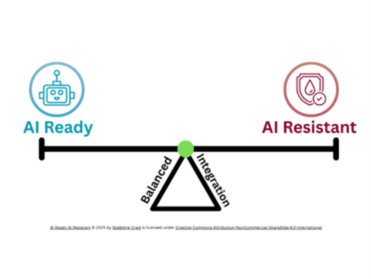
As educators, we need to cultivate two simultaneous mindsets, AI Ready and AI Resistant. These aren’t opposites but instead the two partner as we navigate ethical and meaningful learning in the age of AI. The idea is to not automatically jump to AI models for everything but to instead think carefully about when and why we turn to AI use for ourselves in our personal lives, as educators using AI in our workplace, and then lastly when to use AI in our classrooms with our students. It requires a balanced integration to AI use.
Defining AI Ready and AI Resistant
Being AI Ready means we embrace the presence of AI in our teaching and learning. We develop AI literacy, model ethical tool use, and use AI to enhance creativity, critical thinking and accessibility. Being AI Resistant means we protect what is sacred about learning which is authentic thought, productive struggle, reflection, and personal voice. We make sure we are analyzing, interpreting, and synthesizing for ourselves and ask our students to do the same. It’s not about banning AI use but instead thinking carefully of why and when we turn to AI and how to help our students manage their own use of the growing number of AI tools.
Too AI Ready
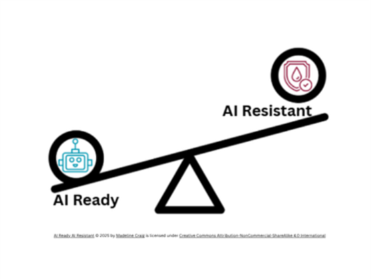
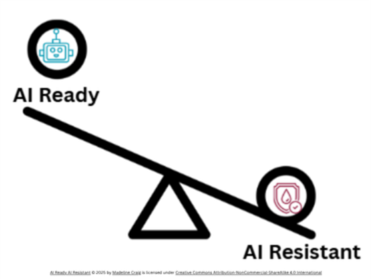
Why do we need balance? Because there are dangers to being either too AI Ready or too AI Resistant. When we lean too heavily toward being AI Ready, we risk valuing speed over substance. We and our students might produce polished work, but without struggle, curiosity, or ownership. We have to be careful not to make learning mechanical and transactional and void of emotion. The fear of a loss of critical thinking and a sense of “linguistic flattening” should make us cautious to not just jump on the latest and greatest AI tools being released almost daily (Kosmyna et al., 2025; Paschalidis, 2025). This mindset requires us to consider the ethical, environmental, and societal issues related to the sudden and dramatic introduction of AI.
Too AI Resistant
There is risk involved in just the opposite. When we lean too heavily toward being AI resistant, we risk the possibilities of innovation and efficiency. If we ban AI from our classrooms, we are missing an opportunity to help our students learn how to use AI responsibly and make those connections to the real world. When using AI detectors tool, we alienate our students when we know that there are numerous issues with these tools, such as bias against non-native English speakers (Gotoman et al., 2025). Research has shown that there is value in using AI tools in our classrooms, including increased academic performance and engagement (Chaudhary et al., 2024). We cannot let fear get in the way of preparing our students for their future work, because we understand that AI is already built into our everyday lives through our cell phones, smart home devices, entertainment, shopping, and healthcare.
Having an AI Ready and AI Resistant Mindset is a fair solution. Balanced integration means designing learning where we use AI but do so reflectively, ethically, and transparently. It should focus on human centered AI use where we continue to value what makes us human while at the same time engaging new technologies that can make us more productive and creative. .A human centered approach means that we are always at the helm of the use of AI, with the technology serving as a partner, assistant, or helper. AI has become a fundamental skill for us all and Ng et al. (2021) recommends that like reading and writing, AI needs to be built into our workplaces and everyday life as an essential literacy. The U.S. Department of Labor (2026) agrees as they recently released AI guidance and along with it a nationwide AI literacy text-based course to make the American workforce AI ready. If you text ‘ready’ to 20202, you will receive 7 days of AI literacy delivered to your cell phone (https://beta.dol.gov/ai-ready).
Teaching Strategies that are AI Ready and AI Resistant
Instead of looking to AI proof all our assessments, we should try to be both AI Ready and AI Resistant in our design choices. This certainly is not an easy task and depending on the course topic, level of the course, and the stakes involved, we must find that ideal balance for ourselves and our students. Sometimes we must decide to move a writing assignment to our physical classroom to ensure that no AI has been used, such as a written final exam to prepare for a professional certification. Other times we might decide to let AI into our classrooms as an active learning opportunity, such as a custom AI bot trained as a course tutor. Having an AI Resistant AI Ready mindset doesn’t always mean an equal balance. Instead, we make educated decisions having full understanding of the risks and benefits of AI. Yet, there are some teaching strategies that align closely with a more balanced approach of AI Ready and AI Resistant such as:
- Scaffolded Assignments: Breaking larger assignment into chunks with ongoing feedback and guidance while allowing the use of AI for brainstorming and revision.
- Project Based Learning: Creating a real-world focus with an essential question or problem to solve by having students work on a semester long collaborative project, using AI to create images, brainstorm creative solutions, and public products.
- Portfolios: Compilation of student work over time – throughout a semester or a program by focusing on showing progress rather than an end product. AI can be used to improve writing, create infographics, or explainer videos.
- Gamification: Building in ed tech tools that provide formative assessment to ensure student learning such as Wayground, Canva Code, or Quizlet. AI is embedded in these tools which allow students to easily create their own gamified study tools.
- Custom AI Chatbots: Building your own or having students build their own bots to help them learn course content, such as a textbook replacement, an engaging class activity, or an ongoing tutor.
Ultimately, the decision to shift your mindset is up to you. Holding both an AI Ready and an AI Resistant mindset simultaneously provides another way to view this sudden and dramatic shift occurring in education. We decide the balance, holding dear to us student critical thinking and learning, while exploring AI tools’ efficiencies for the future. The conversations will continue on our college campuses with or without our voices.
Dr. Madeline Craig is an Associate Professor and Technology Integration Coordinator at Molloy University’s School of Education and Human Services. Her work focuses on AI tools for teachers, project-based learning, and online course design. She has published widely, presents nationally, mentors future educators, and blends scholarly rigor with practical innovation.
References
Chaudhary A. A., Arif S., Calimlim R. F., Khan S. Z., Sadia A. (2024). The impact of AI-powered educational tools on student engagement and learning outcomes at higher education level. International Journal of Contemporary Issues in Social Sciences, 3 (2). 2842–2852. ISSN(P):2959-3808|2959-2461
Gotoman, J. E. J., Luna, H. L. T., Sangria, J. C. S., Santiago Jr., C. S., & Barbuco, D. D. (2025). Accuracy and reliability of AI-generated text detection tools: A literature review. American Journal of IR 4.0 and Beyond, 4(1), 1–9. https://doi.org/10.54536/ajirb.v4i1.3795
Kosmyna, N., Hauptmann, E., Yuan, Y. T., Situ, J., Liao, X.-H., Beresnitzky, A. V., Braunstein, I., & Maes, P. (2025). Your brain on ChatGPT: Accumulation of cognitive debt when using an AI assistant for essay writing task [Preprint]. arXiv. https://doi.org/10.48550/arXiv.2506.08872
Ng, D. T. K., Leung, J. K. L., Chu, S. K. W., & Qiao, M. S. (2021). Conceptualizing AI literacy: An exploratory review. Computers and Education Artificial Intelligence, 2, 100041. https://doi.org/10.1016/J.CAEAI.2021.100041
Paschalidis, A.I. (2025, June 24). AI and the great linguistic flattening. UNESCO Ideaslab. https://www.unesco.org/en/articles/ai-and-great-linguistic-flattening
U.S. Department of Labor. (2026, February 13). U.S. Department of Labor releases AI literacy framework providing foundational content areas, delivery principles to guide nationwide efforts. https://www.dol.gov/newsroom/releases/eta/eta20260213