Navigating the ever-evolving world of generative AI can be daunting for some, exhilarating for others and unsettling for even more. Grounding a course expectation that AI can be a supporting tool, rather than a driver of course work, can set students (and instructors) up for a smooth semester. In an effort to provide an equitable learning experience for all students, I’ve employed several strategies to help students learn to use AI to enhance, not replace, their learning. Suggestions for course strategies intentionally begin broad so faculty from any disciple can adapt the ideas into their field. For additional context, several examples are offered as they were applied in education courses.
The Driver
Using the image of a driver of a car with a computer as a backseat driver (Image 1: AI Brainstorm) can be useful to frame classroom conversation and situate the instructor’s expectations around AI use in student work.
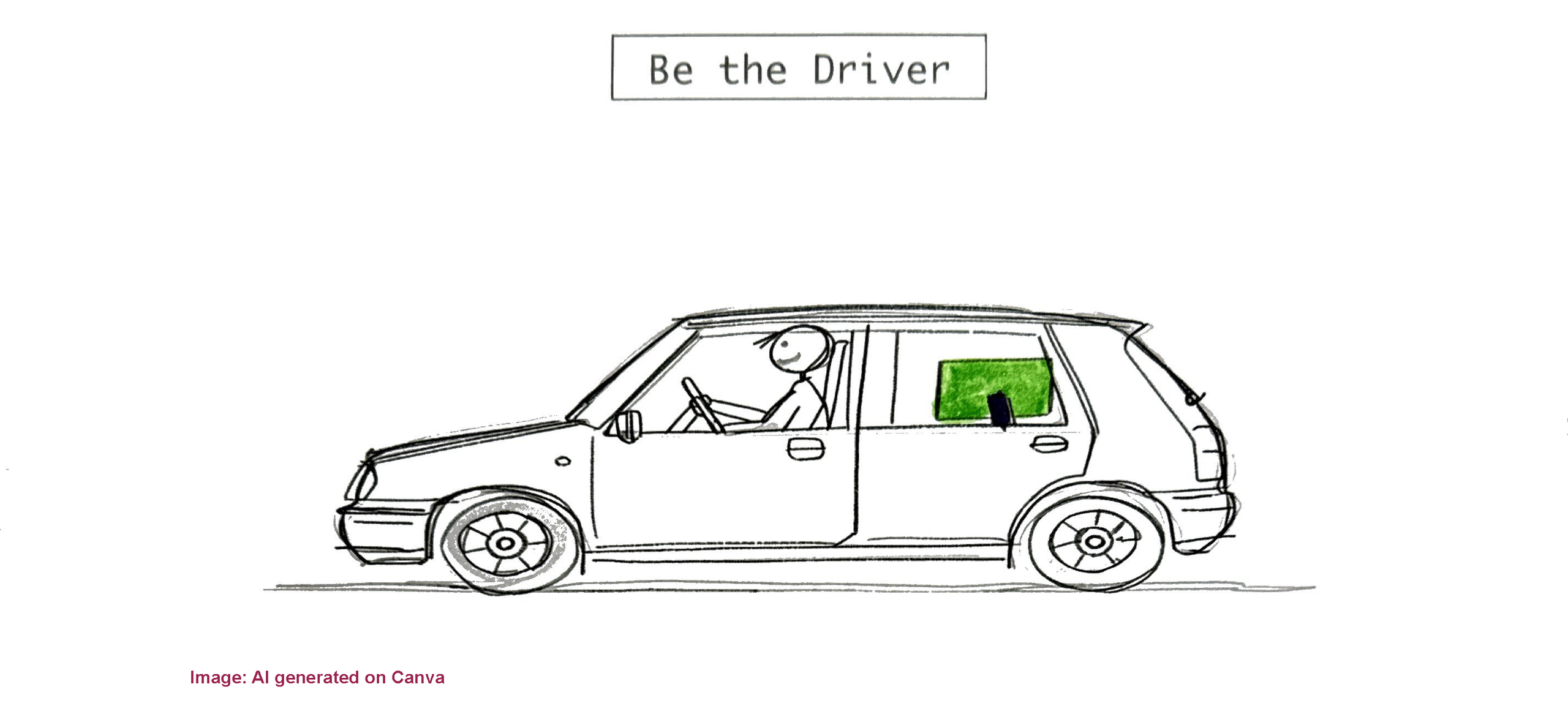
Image 1: AI Brainstorm
During the second course meeting (intentionally not the first to allow for late-comers to hear the same information), I asked students to collaborate with me and generate a class AI policy. Applying the education principle of buy-in (Academic Outreach and Innovation Learning Innovations, 2019) the intention was to use students’ ideas to shape expectations for the semester.
By acknowledging AI as a useful tool, not something to be used in secret, instructors can invite open conversation about how AI can be used to support student learning in a particular course. Instructors can ask students which AI tool they prefer to use and place students in the driver’s seat to lead the conversation about how AI sites are selected and how they evaluate the quality of the output generated. The image of a car (Image 1) can serve as a brainstorm frame on which students capture their experiences with AI. Depending on the size of the class, this can be done anonymously and submitted to the instructor for review or brainstorms can be shared in small groups in class. The latter was most effective for my students. From the small group conversation, students were asked to create a collaborative list that captured sites used regularly with the pros and cons of each site. Each list was then shared with the whole class. This conversation opened the door for students to also share sites they have heard of but not yet tried. From this exchange of ideas, the instructor can generate a list of most used sites and sites most thought about but not used.
Teaching Students to be Cautious Drivers
Using the students’ ideas as a spring board, the instructor determines which sites are appropriate to the course objectives and explains how using those generative AI sites can enhance students’ learning in the course. For example, in education course, sites like ChatGPT may not be as effective as sites like eduaide.ai. or magicschool.ai. After selecting the most appropriate tool the instructor can model, while sharing the potential benefits and challenges, how to appropriately use AI in the course. In education courses, that included showing how to use precise verbs, direct, specific commands and quantifying expected results to generate the desired output.
Instructors can model think-alouds (Green, 2025), practices where instructors verbalize their thoughts, reasoning and decision in real time to explain the strengths and weaknesses of the output to show students how to evaluate and revise output based on course content and assignment specifications.
During this modeling, instructors can demonstrate how to direct the site to generate content that is relevant and appropriate to the course and the task. In some cases, students are unaware of the drawbacks and strengths of particular AI sites. Instructors can discuss, then lead a class exploration of selected generative AI sites reviewing the quality of output in terms of biases and hallucinations (MIT Sloan Teaching & Learning Technologies, 2026a). This process can also support previous conversation about the required quality of the input. To get better outputs, students must be thorough and precise with their input (Valliani, 2023; MIT Sloan Teaching & Learning Technologies, 2026b). Using a subject specific prompt, the instructor can model high quality inputs and critically review the AI output.
It is important to note, this critical review requires students to have an understanding of course content to support their analysis of the output. A handout with some pertinent questions to guide students review of output may be helpful (Image 2: Evaluative Questions). Students can also be encouraged to add their own ideas to the list.
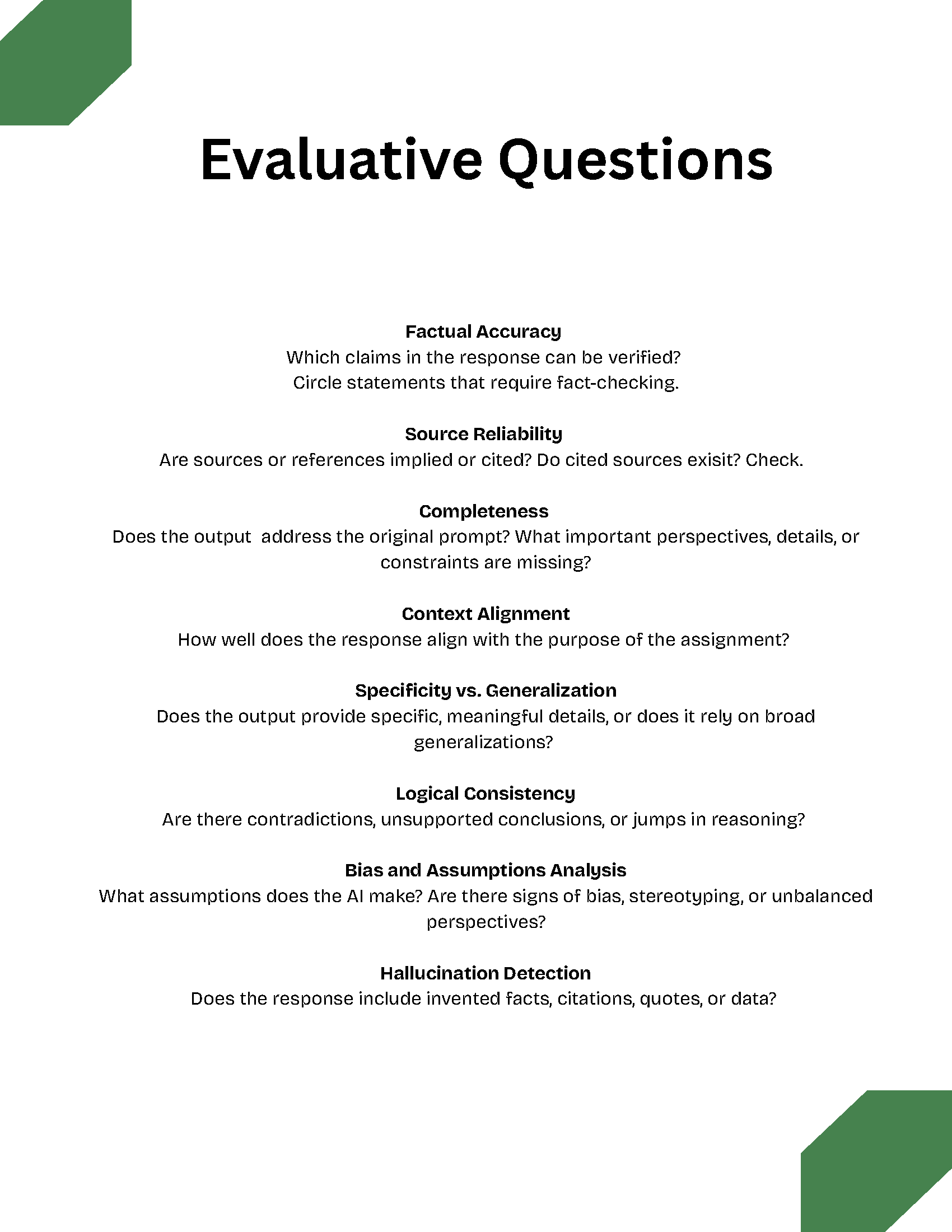
Image 2: Evaluative Questions
Instructors can offer students the chance to begin to evaluate the effectiveness of several sites by modeling a side-by-side split screen comparison of two (or more) sites. This can also be the time for instructors to model how to adjust the setting on the AI site to make usage more efficient. For example, in ChatGPT, settings can be adjusted to instruct the site to stop complimenting your questions and adjust response style and tone.
Moving students to real-time hands-on practice, instructors can assign practice prompts for students to further guide the experience and support students’ developing understanding about how to use AI and how to balance the AI output with their personal learning toward course objectives.
Guardrails: Discussing AI Data & Privacy Policies
Spending a few moments of class time reviewing terms and conditions of the site(s) selected as the backseat driver in a course is important. Students must be taught to consider ownership of data entered into generative AI sites. Students must also be explicitly taught to not upload any personal information or images of people without their consent. Further, uploading copyrighted information, such as journal articles or pages from a textbook, may infringe on copyright. Hosting a copyright expert guest lecturer from the university faculty may be helpful. Universities may have Library Guides already created for students (see Syracuse University Libraries, 2026). Terms and conditions of generative AI sites are updated regularly and the storing of data entered changes regularly.
Transparency in Practice
Rather than fight the AI surge, faculty can elect to show students how to use AI effectively to support course content. After taking class time to establish course AI policies, instructors may create a course AI statement, based on the ideas generated in class conversations and practice with students. The AI Policy, or AI Contract, can outline which sites can be used for select purposes and to what degree they should be used (Image 3: AI in This Course Contract).
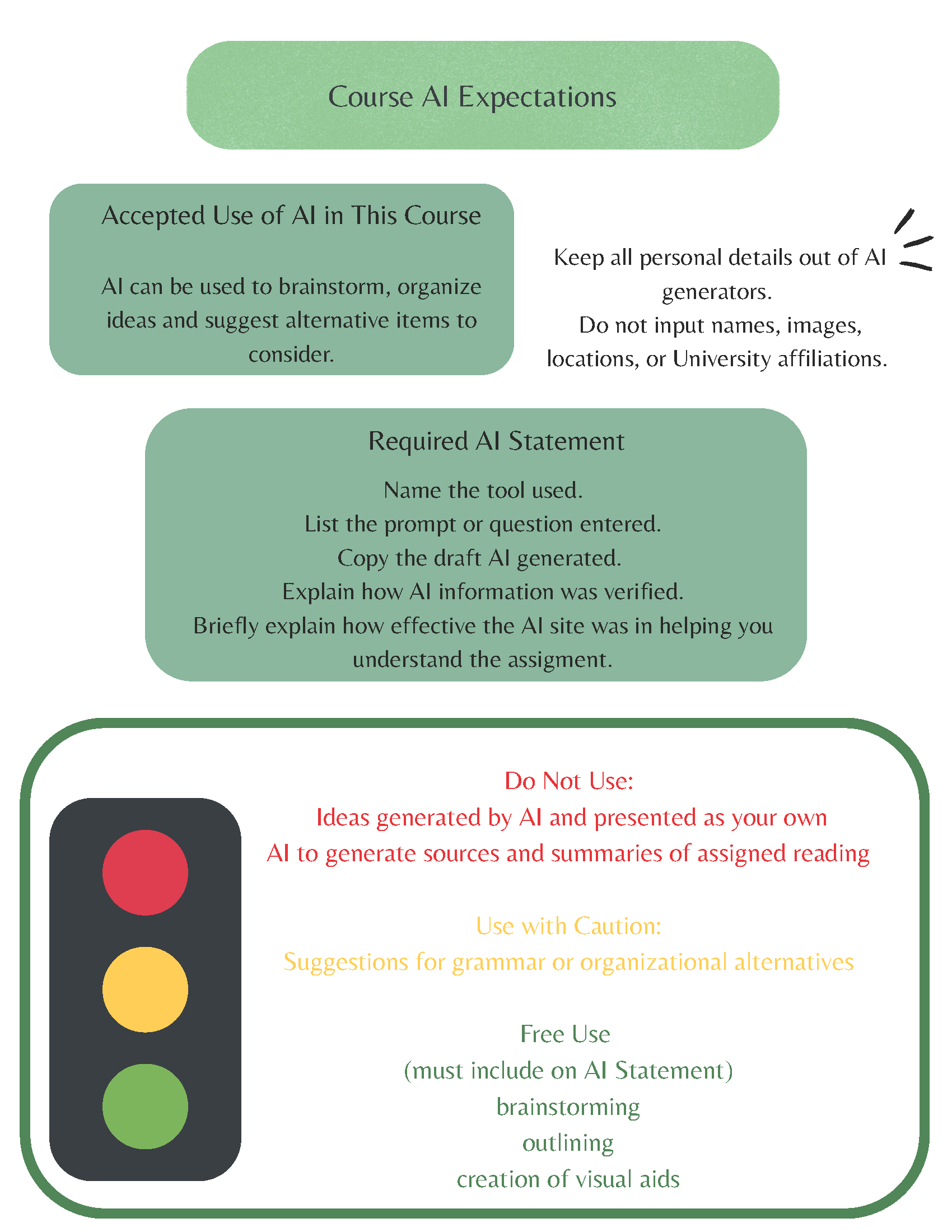
Image 3: AI in This Course Contract
A general AI contract can be posted on the course LMS or on individual assignments. Instructors can also require students share their thinking by submitting an AI Statement with each assignment (Image 4. AI Statement).
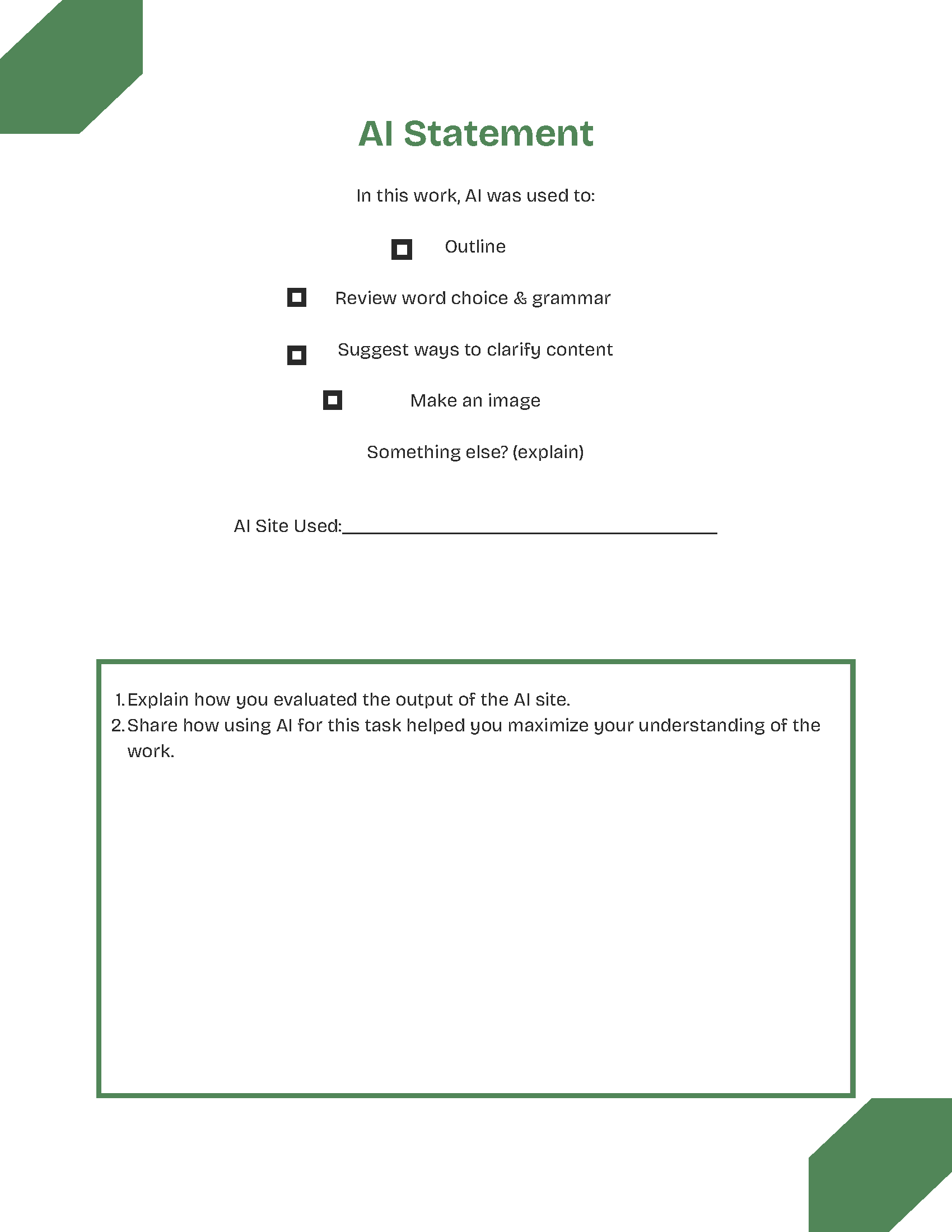
Image 4: AI Statement
With students collaborating in what types and to what degree AI can be used to enhance their learning, AI serves as a supporting tool, rather than a secret intended to be concealed. By articulating ways in which AI was successful, or unsuccessful, students can have the ability to work toward mastering course content by critically examining and refining output and having open and transparent conversations about their learning.
Melissa Parks, PhD. is an associate professor of elementary education at Stetson University in Deland, Florida. Dr. Parks is an active member of the National Science Teaching Association (NSTA) and is currently a member of the NSTA Early Childhood-Elementary Science Teaching and Postsecondary Science Teaching Committees. Her research interests include elementary pedagogies & curriculum and environmental stewardship.
References
Academic Outreach and Innovation Learning Innovations. (2019, February 8). Promoting Student Buy In. https://li.wsu.edu/2019/02/08/promoting-student-buy-in/
Green, Jennifer (2025, March 15). How to Plan a Think Aloud. https://researchschool.org.uk/bradford/news/how-to-plan-a-think-aloud
MIT Sloan Teaching & Learning Technologies. (2026a). When AI Gets It Wrong: Addressing AI Hallucinations and Bias. https://mitsloanedtech.mit.edu/ai/basics/addressing-ai-hallucinations-and-bias/
MIT Sloan Teaching & Learning Technologies. (2026b). Effective Prompts for AI: The Essentials. https://mitsloanedtech.mit.edu/ai/basics/effective-prompts
Syracuse University Libraries (2026, February 18). Artificial Intelligence: Copyright & Intellectual Property. https://researchguides.library.syr.edu/c.php?g=1341750&p=10298151
Valliani, (2023, September 18). The ultimate guide to writing effective AI prompts. https://www.atlassian.com/blog/artificial-intelligence/ultimate-guide-writing-ai-prompts