Developing stronger bonds between K–12 and higher education systems is a longstanding recommendation for educational reform; yet these relationships are often underutilized (Darling-Hammond, 2010; Kirst & Venezia, 2004, Rippner, 2015). One practical and impactful strategy for bridging this divide is through collaborative professional development (PD). When higher education faculty engage in targeted support for local school districts, both sectors benefit: K–12 educators gain access to specialized expertise and resources, while higher education gains deeper insights into the evolving complexities of the K–12 landscape.
The purpose of this article is to encourage college faculty—particularly those in teacher education, content disciplines, or educational leadership—to support P–12 professional development efforts through targeted, needs-based initiatives. Faculty are uniquely positioned to offer professional development that is both research-informed and practice-oriented, providing valuable enrichment to classroom teachers.
What is Targeted Professional Development?
Targeted professional development addresses a specific instructional area where teachers seek further support—either due to time constraints, lack of collaboration, or the complexity of the content. These PD sessions are specialized, content-rich, research-based, and tailored to an identified instructional or pedagogical gap. For example, teachers frequently express challenges in teaching difficult or emotionally charged topics (e.g., historical events, race, gender, trauma, civic conflict) (Schmidt, et al., 2007). Higher education faculty, especially those in social studies, history, or literacy education, can help develop frameworks and instructional tools to support these areas, bridging theory with day-to-day practice. Targeted PD becomes a powerful vehicle for P–20 collaboration when it is created with the following strategic steps in mind:
Step 1: Examine the Current Landscape
Begin by reviewing the professional development currently offered within your region (via local school districts, BOCES, or professional organizations). What are the prevailing trends? Where are the gaps? Talk to teachers, school administrators, and curriculum directors. For instance, in my work with teacher candidates and school partners, concerns repeatedly surfaced about how to approach sensitive and controversial content, such as September 11th. Despite a growing need, few professional learning sessions address how to facilitate emotionally difficult conversations with students.
Step 2: Identify the Purpose of Your PD
Once a need is identified, define the specific content or instructional focus of the PD. Is it content-based (e.g., teaching about September 11th)? Skill-based (e.g., using primary sources in history instruction)? Strategy-based (e.g., trauma-informed teaching practices)? Let your design be informed by both the expressed needs of local educators and the research evidence from your discipline. For example, if teachers request support in teaching topics related to social justice, your PD might include model lessons, instructional frameworks, and time for collaborative planning. Consider integrating school-wide or district-wide projects to create momentum—for example, a grade-level initiative where all 8th graders complete a civic engagement project guided by a framework introduced in the PD. Work with our regional social studies coordinator led to the need to support teachers when exploring difficult content surrounding September 11th. By pooling faculty expertise, we provided a comprehensive PD focusing on the use of children’s literature using an Inquiry Design Model ™ to introduce and explore difficult concepts such as the War on Terror and Islamophobia.(Serure, 2024; Wild, 2024).
Step 3: Incentivize Participation
Teachers are more likely to attend PD when it provides tangible benefits. Consider what immediate takeaways you can offer:
- Gift cards for classroom supplies
- Class sets of relevant texts
- Instructional materials or manipulatives
- Toolkits for specific instructional strategies
- Templates or frameworks ready for classroom use
- Even small incentives—such as a set of historical fiction novels or lab supplies—can go a long way in increasing participation and enthusiasm.
Most importantly, design professional development opportunities that offer continuing education credit, micro-credentials, or pathways toward graduate-level coursework. These options enhance the legitimacy of the learning experience and emphasize its lasting value.
Step 4: Secure Funding to Support Your Efforts
According to recent data from the National Center for Education Statistics at IES up to 94% of teachers spend personal funds on classroom supplies and other items students need to succeed. Although the amount differs depending on the type of school (private vs. public; rural, suburban, urban), according to Litvinov (2022) the amount is on the rise and indicative of the teachers’ need for additional resources to support student learning and to make their classrooms welcoming such as books, art supplies, and nonperishable items. One way to ensure your PD will be enticing to teachers is to provide incentives for attending. By pursuing small grants or mini-funding opportunities, you can provide teachers with:
- University-supported mini-grants for community engagement
- Local education foundation grants
- National programs supporting K–16 partnerships
- Donations from local establishments
These funds can cover materials, refreshments, books, or stipends for teacher attendees. Partnering with your university’s grant office can streamline the process.
Step 5: Establish a Marketing and Communication Plan
Once you have developed the purpose of the PD, work with your partners to design clear and concise promotional materials and outline clear learning objectives, incentives, and logistics. Next, distribute the materials through school district channels, teacher networks, and regional professional development associations. Even consider hosting information sessions or short virtual previews of your PD content to increase interest. Enlist teacher champions who can help spread the word and share testimonials.
Step 6: Build and Sustain Collaborative Partnerships
PD should not be a one-time event. Establish ongoing relationships with district leaders and teachers. Co-develop future PD sessions, co-author resources, or invite teachers to participate in research-practice partnerships.
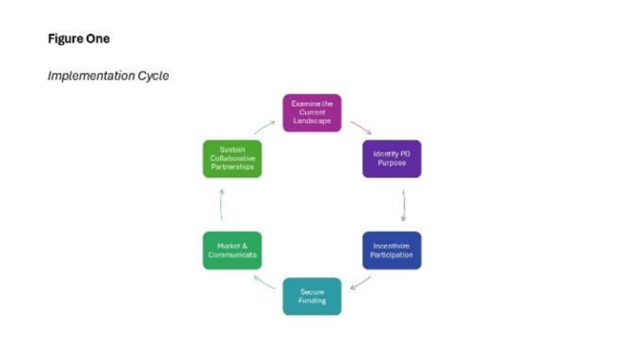
Figure 1: Implementation Cycle
Conclusion: Mutual Benefit and Lasting Impact
P–20 partnerships thrive when they are grounded in mutual respect, shared goals, and authentic collaboration. Faculty in higher education have an important role to play—not just as researchers and content experts—but as partners in educational transformation. By designing targeted, responsive professional development for teachers, faculty can support instructional improvement, foster lasting community connections, and reinvigorate their own teaching and scholarship in the process.
Dr. Karen Poland, EdD, is an Assistant Professor in the College of Education at Niagara University, where she brings a broad P-20 perspective to her work having served as a social studies teacher, staff developer, curriculum developer, and director of career and technical education programming. Her scholarly interests include curriculum development and teacher preparation, the history of education, and social studies and civic education. She is actively engaged in the educational community, serving on various local and state educational associations to further advance the field.
References
Darling-Hammond, L. (2010). The Flat World and Education: How America’s Commitment to Equity Will Determine Our Future. Teachers College Press.
Grant, S. G., Lee, J., & Swan, K. (2014). Inquiry design model (IDM) Blueprint™. https://c3teachers.org/idm/
Kirst, M. W., & Venezia, A. (2004). From High School to College: Improving Opportunities for Success in Postsecondary Education. Jossey-Bass.
Litvinov, A. (2022, October 14). Out-of-Pocket Spending on School Supplies Adds to Strain on Educators. NEA Today. https://www.nea.org/nea-today/all-news-articles/out-pocket-spending-school-supplies-adds-strain-educators
Rippler, J. A. Barriers to success? The role of statewide education governance structures in P-20 council collaboration. Education Policy Analysis Archives, 23(74). http://dx.doi.org/10.14507/epaa.v23.1909
Schmidt, R., Armstrong, L., & Everett, T. (2007). Teacher resistance to critical conversation: Exploring why teachers avoid difficult topics in their classrooms. The NERA Journal, 43(2), 49-55.
Serure, D. F. (2024). Inquiry Design Method: Teaching September 11, 2001 and Post-9/11 History with Children’s & Youth Literature. The Social Studies, 1-13.
Wild, N.R. (2024). The Other Side: Preschool Children’s Experience of a Read-Aloud Focused on Social Justice. Early Childhood Education Journal. https://doi.org/10.1007/s10643-024-01683-z